Why Isn’t ChatGPT Recommending My Business? For Liddell Stor-It, the Answer Was Bing
Liddell Stor-It tracked 34 customer questions with Halogen Presence™. Its AI visibility rose from 7% to 43% in five months, and one Bing indexing fix took its ChatGPT visibility from 6% to 44% in a week.

Liddell Stor-It, a family-owned portable storage company in Arkansas · Published November 2, 2026
Prepared by Halogen. Published with the consent of Liddell Stor-It.
The short version
If Google Gemini recommends your business but ChatGPT doesn't, check Bing. ChatGPT leans on Bing's index to find pages, and one site bug can hide most of a site from Bing while Google still sees it. That is what Halogen Presence™, Halogen's AI visibility platform, found for Liddell Stor-It. Between April 17 and September 18, 2026, the company's average visibility across ChatGPT, Gemini and Claude rose from 7% to 43%, on 34 questions it wrote itself.
- AI visibility rose six-fold in five months, on every engine: ChatGPT from 6% to 53%, Gemini from 12% to 38% and Claude from 3% to 38%.
- One Bing indexing fix took ChatGPT from 6% to 44% in a single week. Halogen Presence's engine-split check traced ChatGPT's low score to a canonical-tag bug that kept most of the site out of Bing's index.
- Liddell Stor-It now appears for 8 of 28 unbranded questions, including "Who do people recommend for portable storage services in Paragould?"
- Every fix was shipped in-house. Clay Liddell, the company's technical operator, worked from Halogen Presence recommendations on his own schedule.
The business
Liddell Stor-It is the portable storage division of Liddell Stor All, a family-owned storage company based in Paragould, Arkansas, and in business since 2017. It delivers steel storage containers to homes, businesses and job sites in 11 markets across four states:
- Arkansas: Paragould, Jonesboro and West Memphis
- Tennessee: Memphis, Bartlett, Germantown and Collierville
- Mississippi: Southaven, Olive Branch and Horn Lake
- Missouri: Poplar Bluff
More of Liddell Stor-It's customers now ask an AI assistant who to rent from instead of running a search. When the company started tracking with Halogen Presence on April 17, 2026, it appeared in 7% of AI answers to its priority questions: 12% on Gemini, 6% on ChatGPT and 3% on Claude. The team needed to know why AI engines were passing it over, and what to fix first.
What we did
Starting April 17, 2026, Halogen Presence ran Liddell Stor-It's 34 questions on ChatGPT, Google Gemini and Claude on a recurring schedule and recorded whether each engine named the company. Presence also scored the website in a Site Health Audit across eight AI-readiness categories, then turned what it found into recommendations ranked by impact.
The test was hard by design:
- The client wrote the prompts. Liddell Stor-It chose all 34 tracked questions itself, based on how its customers ask. None were AI-suggested.
- Most never name the brand. 28 of the 34 are unbranded, such as "Which portable storage companies in Arkansas offer the most flexible rental durations?" The brand appears only if the AI engine decides to recommend it.
- They are local and specific. 11 ask for the top portable storage providers in a named city, from Paragould to Memphis. Others add constraints like "near Paragould" or "in Northeast Arkansas."
- Each engine finds websites differently. Gemini reads Google's index, while ChatGPT leans on Bing's index to find pages before it fetches them. A site can be strong on one engine and nearly invisible on another, as Halogen found on its own site.
1. AI visibility rose six-fold, from 7% to 43%, in five months
Liddell Stor-It's average visibility across ChatGPT, Google Gemini and Claude climbed from 7% in mid-April to 43% by mid-September 2026, and every engine at least tripled.
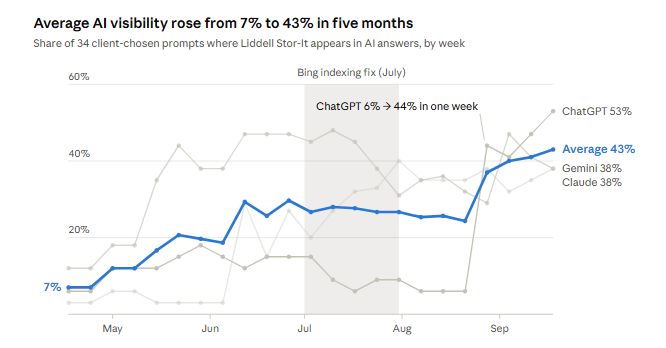
Source: Halogen Presence, weekly visibility across 34 tracked prompts, April 17 to September 18, 2026.
| Unbranded prompt, as the client wrote it | ChatGPT | Gemini | Claude |
|---|---|---|---|
| "How can small businesses handle temporary inventory storage effectively near me? I'm located near Paragould Arkansas." | Yes | Yes | Yes |
| "Who do people recommend for portable storage services in Paragould?" | Yes | Yes | No |
| "What are the top portable storage container providers in Paragould, Arkansas?" | No | Yes | Yes |
| "How quickly can I get a portable storage container delivered in Paragould?" | No | Yes | Yes |
| "What local companies offer on-site storage container delivery in Paragould?" | No | Yes | Yes |
| "Which companies provide flexible rental options for portable storage in Northeast Arkansas?" | No | Yes | Yes |
| "What are the top portable storage container providers in West Memphis, Arkansas?" | No | Yes | No |
A sample of unbranded prompts where Liddell Stor-It is now named, by engine, as of October 2026.
2. The client's own operator shipped every fix from plain-language recommendations
Liddell Stor-It's technical operator, Clay Liddell, worked through Halogen Presence recommendations independently and on his own schedule, shipping fixes as he had time. That worked because Halogen Presence writes every recommendation in plain language and ranks it by impact: what is wrong, the evidence, the exact fix, who should do it, how long it takes and how to confirm it landed. The July 2026 Bing checklist is typical. It laid out four steps, each with an owner, an effort estimate from 20 minutes to 3 hours and an expected impact, plus when to expect results (2 to 4 weeks). The monthly Presence report does the same for content, sorting actions into "this week," "next 2 weeks" and "month 1."
"I run the tech side of a family storage business, not an SEO agency. What made Halogen Presence work for me is that every recommendation came with the why and the exact fix, so I could knock items out whenever I had an hour free. The Bing fix was a single template change. About a month later, we were showing up in ChatGPT for the questions our customers actually ask."
Clay Liddell, Technical Operator, Liddell Stor-It
3. Gemini could see the business. ChatGPT couldn't, until one Bing fix took it from 6% to 44%
When Gemini recommends a business and ChatGPT doesn't, the cause is often where each engine finds pages, not the content on them. Gemini reads Google's index, while ChatGPT leans on Bing's. Halogen Presence tracks ChatGPT, Gemini and Claude separately, which is how it spotted the gap: in July 2026, Liddell Stor-It appeared in 44% of Gemini's answers but only 15% of ChatGPT's. Halogen calls this side-by-side comparison the engine-split check.
The split pointed to a site bug nobody at the business could see: a canonical tag error. Every service-area page told search engines that the homepage was the "real" version of that page. Google sometimes overrides that kind of mistake, but Bing follows it strictly, and had indexed only 5 of the site's 20 to 25+ pages. With most of the site missing from Bing, ChatGPT rarely found the pages that answer local questions.
Clay fixed the page template on July 20 and pushed every page to Bing through IndexNow on July 29. In the week ending August 28, ChatGPT visibility jumped from 6% to 44%. That same week Gemini slipped 3 points and Claude gained 3, the pattern you would expect from a fix that changed only what Bing could see. By September 18, ChatGPT was the strongest of the three engines at 53%.
"When Gemini can see a business and ChatGPT can't, the content usually isn't the problem. The index is."
Mario V. Adoc, co-founder and CEO, Halogen
Without engine-by-engine tracking, this gap would have looked like a content problem. Halogen Presence pinpointed a technical cause, the fix was a single template change, and the payoff showed up in ChatGPT about four weeks after the re-index, at the far end of the 2 to 4 weeks the checklist predicted.
How to show up in AI answers: the steps Liddell Stor-It took
To show up in AI answers, a business needs pages AI engines can find, read and quote, plus a way to see each engine separately. These are the steps Liddell Stor-It took, in order, with the date each one shipped.
- Check each AI engine separately. Track the questions your customers ask on ChatGPT, Gemini and Claude, and compare the engines side by side. A wide gap between them points to the cause. Liddell Stor-It: tracked in Halogen Presence from April 17, 2026.
- Give every market its own page. A page per city or service area gives AI engines something specific to cite for "near me" and "in [city]" questions. Liddell Stor-It: a service-area page for each of its 11 markets, April to May 2026.
- Let AI crawlers in. Allow AI crawlers in robots.txt, including the agents that fetch pages live when someone asks a question, and declare your sitemap. Halogen's own site missed the live-fetch agents at first. Liddell Stor-It: GPTBot, ClaudeBot and Google-Extended allowed, April to May 2026.
- Add structured data. Schema markup tells AI engines what each page is about. Liddell Stor-It: LocalBusiness, Service, Product/Offer with pricing, FAQPage and BreadcrumbList, April to May 2026.
- Answer your customers' questions on your site. An FAQ page and plain-language guides give AI engines direct answers to quote. Liddell Stor-It: an FAQ page and guides on container sizing, pricing, packing, moving and renovation storage, April to May 2026.
- Make every page point to itself. Each page's canonical tag should name that page's own URL. View the page source, search for "canonical" and check. Liddell Stor-It: fixed site-wide with one template change, July 20, 2026.
- Submit your site to Bing. Verify the site in Bing Webmaster Tools, submit the sitemap and request indexing for key pages. Search
site:yourdomain.comon Bing to see what it has indexed. Liddell Stor-It: July 2026. - Push updates with IndexNow. IndexNow tells Bing about new and changed pages right away instead of waiting for the next crawl. Liddell Stor-It: every URL submitted July 29, 2026.
Three Halogen case studies, three different problems
Halogen's three published case studies each found a different reason AI engines were getting a business wrong. That is why Halogen Presence tracks every engine separately instead of rolling them into one score.
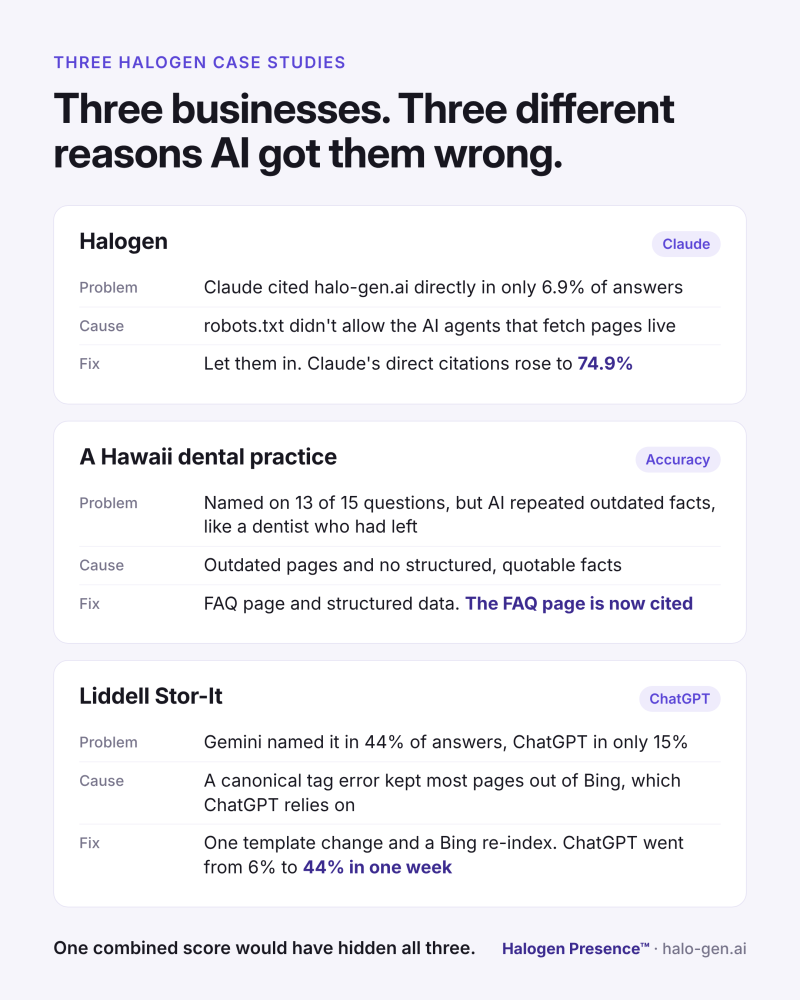
A single combined score would have hidden all three problems, because each one showed up on one engine or in one kind of answer and not the others.
What's next
Liddell Stor-It is strongest in its home market of Paragould. The next phase pushes outward:
- Win the expansion markets. 9 of the 11 "top providers in [city]" prompts, 7 of them in the Memphis metro, don't yet surface Liddell Stor-It on any engine. Each market needs its own local guides, not just a service-area page.
- Act on the October recommendations. The latest Site Health Audit scores the site 68 out of 100 and flags two critical gaps: no quotable statistics and no author attribution on the guides. Halogen Presence recommends a sourced container-capacity table, bylines from owner Lance Liddell, a full transcript of the storage demo video and two or three customer stories.
- Connect visibility to phone orders. Most Liddell Stor-It customers book by phone. Asking every caller how they found the company would show how many rentals start with an AI answer, the way a "ChatGPT/AI Search" intake option did for a Hawaii dental practice.
Common questions
Why isn't ChatGPT recommending my business?
Often because ChatGPT can't find your pages. ChatGPT leans on Bing's index to find pages, so a site Bing hasn't indexed is rarely cited, even when Google and Gemini see it fine. Blocked AI crawlers and missing answers to customers' questions are the other common causes. Liddell Stor-It had only 5 of its 20 to 25+ pages in Bing because of a canonical tag error; after the fix, its ChatGPT visibility rose from 6% to 44% in one week.
Why does my business show up in Gemini but not ChatGPT?
Because the two engines find pages through different search indexes. Gemini reads Google's index, while ChatGPT leans on Bing's, and Google sometimes overrides site errors that Bing follows strictly. Comparing the engines side by side, which Halogen calls the engine-split check, shows when this is happening. Liddell Stor-It sat at 44% on Gemini and 15% on ChatGPT until it fixed one such error.
How do I get my business into ChatGPT's answers?
Make sure Bing can find and index your pages, then answer your customers' questions on them. Search site:yourdomain.com on Bing to see what it has indexed, check that each page's canonical tag points to itself, submit your sitemap in Bing Webmaster Tools and push updates with IndexNow. The eight steps Liddell Stor-It took are listed above.
How long does it take to show up in AI answers after a fix?
It depends on what the fix touches. Changes AI engines read directly can show up within days, as Halogen saw with FAQ markup on its own site. Fixes that wait on a search index take longer: Liddell Stor-It's Bing fix reached ChatGPT about four weeks after the re-index.
What is AI visibility?
AI visibility is the degree to which a brand appears in AI-generated answers across platforms like ChatGPT, Google Gemini and Claude. Halogen Presence reports it as the share of tracked prompts where a brand is named, for each platform. Liddell Stor-It's average rose from 7% to 43% between April and September 2026. See the Halogen glossary.
Can a small business improve its AI visibility without an agency?
Yes. Clay Liddell, Liddell Stor-It's technical operator, shipped every fix himself, from service-area pages and structured data to the canonical tag fix. He worked from Halogen Presence recommendations written in plain language and ranked by impact.
What does Halogen Presence cost?
Starter is $99/month and tracks 50 buyer questions and 3 competitors across ChatGPT, Claude and Gemini. Growth is $299/month for 150 buyer questions, 5 competitors and a strategy session included with annual billing. Scale is $699/month for 350 buyer questions, 10 competitors and 2 brands, with a strategy session every quarter. A one-time Baseline Audit, a $199 snapshot of your AI visibility, is also available, and the full $199 is credited toward your first month of Growth or Scale if you subscribe within 30 days. Every new subscription comes with a 30-day money-back guarantee on the first payment. See pricing.
The free AI Visibility Check is the simplest way to see where you stand first.