AI Is Recommending Dental Practices. Most Dentists Have No Idea Which.
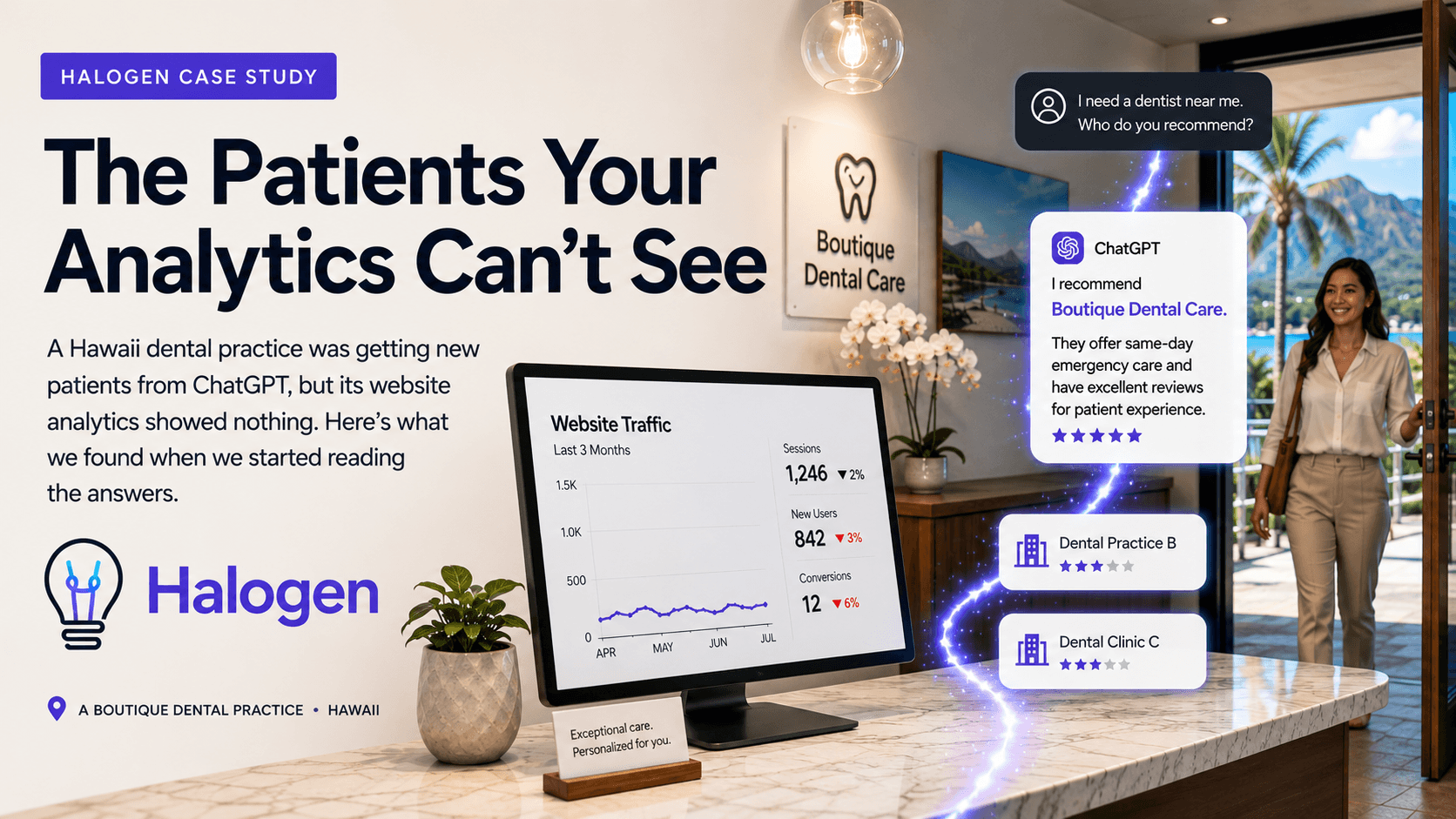
A boutique dental practice in Hawaii was receiving new patients from ChatGPT. Its website analytics showed nothing. Here's what we found when we started reading the answers.

A boutique dental practice · Hawaii · Published July 29, 2026
Prepared by Halogen. Published with the consent of the practice, which asked not to be named.
The short version
Patients are asking AI assistants for a dentist, and the assistants are answering by name. Over three months, five new patients told the practice they found it through ChatGPT, roughly $5,000 in patient value, while its website traffic never moved. The channel was already working before we arrived; the practice simply had no way to see it.
Three things this case study shows every dental practice owner:
- AI is already recommending you, or your competitors, and it won't show up in your analytics. Three competing Hawaii practices sat at or near zero visibility the entire time.
- What the assistants say changes every few days, so a single check tells you almost nothing.
- The assistants get facts wrong. One was sending pricing questions to a competitor; another was naming a dentist who had left.
The practice
A visitor to Hawaii breaks a crown on a Tuesday. They don't open Google Maps and work through four listings. They ask ChatGPT for a dentist nearby, and for most of them, whatever it says is the whole search. They call the first name it gives them.
The practice at the center of this study is a boutique dental office in Hawaii.
It is an established practice with genuine credentials, a leadership role in the regional dental community, and is not contracted with any insurance company. (At the practice's request, this case study does not name it or its dentists.)
"For twenty years, being findable meant being on Google. Nobody told me the rules had changed. I had no idea a patient could ask a chatbot for a dentist and get sent straight to us, or straight past us."
What we did
Halogen Presence™, our AI visibility measurement platform, began tracking fifteen high-priority patient questions across ChatGPT, Google Gemini, and Claude on April 17. Questions ranged from branded ones naming the practice directly to unbranded ones like "What is the best dentist in the area?" and "Which dentist offers cosmetic procedures nearby?"
The audit surfaced four problems, none visible from the front end of the website: a Google Business Profile name that violates Google's guidelines, a lingering stale page in the sitemap dated 2013, service pages that existed but weren't structured for AI engines to read, and no machine-readable version of the lead dentist's credentials.
We addressed the last of these by adding structured data, the machine-readable summary that tells an AI engine what a business is, where it is, and who works there:
| Date | Deliverable | Validation |
|---|---|---|
| April 28 | FAQ page with structured data for all 15 questions | Live |
| May 20 | Practice and website structured data across the site | Live, 0 errors |
| May 20 | Team page structured data, each dentist tagged individually | Live, 0 errors |
The team page required one non-obvious correction. The intuitive schema type for a doctor, Physician, is not valid for listing staff, and silently fails. The correct pattern tags each dentist as a Person with their specialties attached.
Four weeks from kickoff to implementation. No redesign, no ad spend, no blog, no rebrand, and minimal time from the practice. The practice had also, in April, added a "How did you hear about us?" question to its new-patient intake form, with "ChatGPT/AI Search" as one option. That single field turned out to be the only instrument that caught what happened next.
1. Five patients found the practice through AI. The website traffic never moved.
Five patients selected "ChatGPT/AI Search" on the practice's intake form: one in mid-May, two in early June, two in early July.
At a $1,000 average lifetime value for a cosmetic procedure visit or local families who return for years, that is roughly $5,000 in patient value from a single AI assistant over three months. That figure is deliberately conservative: industry estimates put the lifetime value of a general-practice dental patient closer to $6,000 to $10,000, and higher still for the implant and cosmetic cases a fee-for-service practice depends on. By either measure, the value at stake in this one channel is real money.
We are not claiming the work produced those patients; the channel was already sending them. What we can claim is this: before this engagement, no one could see that channel existed, whether it was growing, or that a competitor was intercepting the practice's pricing questions. You cannot grow, protect, or defend a channel you cannot see, and this one was invisible until we measured it. That is what the engagement delivered. And here is the comparison worth sitting with: a solo practice typically spends $1,500 to $3,000 a month on SEO and digital marketing, none of which can see or measure the AI channel that delivered these five patients. Knowing what the AI assistants say about your practice, and being able to act on it, costs a fraction of what most practices already spend trying to be found.
The website traffic never moved. Nineteen months of analytics show daily sessions in January and February 2026, before any work began, running higher than most of the post-engagement period. Traffic dipped in March and April, then recovered to roughly where it started. Year over year against 2025, the incremental gain is fewer than twenty sessions a month.
Five patients is invisible at that scale. Against roughly 500 sessions a month, five arrivals don't register as a trend, and nothing in the analytics identifies them as coming from an AI assistant. Some AI-referred patients call the number the assistant hands them and never load the site at all. Others click through but arrive without a referrer that Google Analytics can attribute. Either way, they land in the same undifferentiated bucket as everyone else.
The channel isn't hidden because it's small. It's hidden because it doesn't identify itself. A dropdown on an intake form is enough to prove the channel exists, but it can't tell the practice whether it's growing, which questions are winning patients, or when a competitor starts appearing in the same answers. That is what continuous measurement is for, especially since the AI engines change how they source and rank businesses without notice.
When the practice's owner saw these results, she raised the obvious alternative: maybe the new patients were just a summer bump, with school out and tourists arriving. It was a fair question, so we checked the practice's own history. In 2025, summer months averaged 15.4 sessions per day against an annual average of 15.2. August, peak travel season, was among the year's lowest months, and the 2025 peak was October. There is no summer surge in this practice's numbers for the season to explain.
"These were real patients, and my analytics had nothing to say about them. If we hadn't asked at the front desk, I'd have gone on assuming word of mouth and never known there was a whole channel I couldn't see."
2. Your AI visibility changes every few days. You'd never know.
The first finding of the engagement was not what anyone expected. The practice was already being recommended. On the first day of measurement, before anything on the site changed, it was named in the AI assistants' answers for 13 of the 15 tracked questions on ChatGPT and again 13 of 15 on Gemini. In other words, when a patient asked one of those assistants for a dentist offering cosmetic procedures in the area, the assistant already knew the practice and answered for it. That is a single day's reading, which matters for reasons that become clear below, but the direction was unmistakable: the practice was already showing up.
Three competing Hawaii dental practices, tracked across the same period, registered at or near zero on all three assistants. Same market, same industry, four practices, and a range from almost nothing to almost everything. Nothing external predicts which practice lands where: not size, not location, not how the website looks. Two of these practices are effectively absent from AI answers in their own market and almost certainly believe they're fine.
And the position moves on its own. Between June 10 and July 23, a window in which the website was not modified once, tracked questions changed status constantly. The clearest case was a branded question naming the practice and one of its routine services, where ChatGPT changed its answer ten times between June 16 and July 20, alternating between naming the practice and not naming it. Claude and Gemini held steady throughout. No collection errors occurred. On one day in mid-July, ChatGPT returned no mention of the practice at all for a question that named it directly.
So why does it waver? Part of the reason is fixable, and part of it isn't. When an AI engine is confident about a business, because its identity is strong and consistent across the sources the engine trusts, its answers are steadier; when the picture is thin or contradictory, small differences in phrasing or which sources surface will tip the answer either way. Strengthening how a practice is represented across the web genuinely reduces that wavering, and it is part of the work. But it does not remove it. The crowns question is the tell: it names the practice directly, the easiest kind of question a well-defined business can face, and one engine still flipped on it ten times while two held perfectly steady. If authority were the whole story, all three engines would waver together. They don't. Some of the movement is just how each engine retrieves and generates in the moment, which no amount of authority work controls. You can lower the volatility. You cannot eliminate it.
That instability leads somewhere important. Our April and July reports both list "Which dentist has the best reviews in the area?" as a question where the practice does not appear. Both reports were correct for the day they ran. The daily record fills in what they couldn't: between those two reports, at least one engine named the practice on roughly fifteen separate days.
A periodic audit measures the day it ran. It is why this case study carries no before-and-after visibility score: with the number moving every few days, we could pick a low day in April and a high day in July to manufacture a dramatic improvement, or the reverse to manufacture a decline, from the exact same underlying reality. What is trustworthy is the pattern over time, not two convenient dates. And because part of the volatility is irreducible, no one-time fix ends the need to watch. Authority work lowers the swings; monitoring manages the remainder. That is the case for measuring continuously rather than assuming a single result holds.
3. A competitor is answering your pricing questions. AI is naming a dentist who left.
Tracking whether a practice appears in an answer is one thing. Reading the answer is another. Four findings came only from the response text.
A competitor is answering the practice's pricing questions. Asked what dental implants cost at the practice, ChatGPT notes that pricing isn't on the practice's site, then fills the gap by citing a competing dental practice in the same market. Gemini fills it with third-party market data. This is the highest-intent question in the funnel, asked about a practice that takes no insurance, and the answer currently points a ready-to-book patient at a competitor. It is the most valuable unclaimed opportunity we found, and the fix is straightforward: publish the practice's own pricing guidance and payment options so the assistants have something of the practice's own to cite.
The AI assistants are repeating facts that aren't true. Asked what patients say about their experiences, Gemini names two dentists who no longer practice at the office, and describes one of them as the practice's pediatric dentist. Separately, ChatGPT tells patients the practice accepts CareCredit financing, which it does not. Neither claim came from the practice. Gemini is reading old reviews on the testimonials page; ChatGPT pulled the CareCredit detail from a third-party directory. In both cases an assistant is confidently stating something wrong, and the practice would never have known without reading the answers. This is the finding most worth carrying to any practice owner: the assistants will fill gaps with whatever they can find, and what they find is often out of date.
Keyword-stuffed naming has spread beyond Google. A variant of the non-compliant Google Business Profile name now appears in the URL of a third-party business directory, and ChatGPT cites that directory when describing the practice. Correcting the profile name is worth doing on its own terms. Whether it clears the directory variant is a separate and slower question.
The structured data we added is already being cited. ChatGPT now cites the practice's own FAQ page when answering patient questions about insurance and cosmetic procedures. That FAQ page did not exist before April 28; we built it as part of this engagement. Across three answers, ChatGPT cites six different pages from the site, and both engines now describe the practice's insurance position and cosmetic procedure availability accurately.
"Seeing the actual answers was the part that got me. A chatbot was telling patients we take a kind of financing we don't, and naming a dentist who left. I'd never have caught it, because I never thought to ask what these things were saying about us."
What's next
The most immediate opportunity is the one costing the practice patients right now. When someone asks an AI assistant what implants cost at the practice, the answer sends them to a competitor, because the practice publishes nothing of its own for the assistant to cite. Publishing clear pricing guidance and payment options closes that gap directly.
Two accuracy problems come next, and both are quick. The Google Business Profile name needs correcting, both because it violates Google's guidelines and because variants of it have already spread into directories the assistants read. And the testimonials page needs updating so that old reviews stop feeding Gemini the names of dentists who have moved on.
Then there is a structural gap worth understanding, because it explains where structured data stops helping. Questions anchored to a place, like "best dentist in the area," do surface the practice. Questions about a category surface nobody. "What is sedation dentistry and who might benefit from it?" returned no mention of the practice on any engine, on any day, across the entire period. Structured data tells an engine what a business is and where it is. It gives the engine no reason to name that business when someone asks a general question that mentions no one. Winning those questions means publishing content that answers them, which is why dedicated service pages for pediatric, sedation, implant, and cosmetic care are the natural next investment.
Underneath all of it is the discipline the engagement established. Visibility moved on its own every few days, competitors sat unaware in the same market, and the assistants quietly repeated things that were no longer true. None of that is visible without continuous measurement. Alerting catches a drop the week it happens. A quarterly audit catches it a quarter late.
Why this practice had a head start
It's worth being honest about one thing. This practice didn't start from zero. It has a well-regarded lead dentist, strong credentials, years of real patient reviews, and an established reputation in its market. That's the reason the AI assistants were already recommending it before we changed anything.
AI assistants tend to recommend businesses that already look trustworthy across the web. A practice with that kind of track record has an easier time appearing, and most of the work is making sure the assistants can find and correctly read what's already true. A newer practice, with fewer reviews and less of a public footprint, has more to build first, and measurement shows exactly what to strengthen and whether it's working. Either way you need to see what the assistants are saying. The starting point just changes how much of the work is fixing versus building.
Common questions
Is this actually happening, or is it hype? It's happening. In this engagement, five new patients told the practice at intake they found it through ChatGPT, and the assistants were naming the practice for the large majority of common patient questions. Patients increasingly ask an assistant for a dentist the way they used to ask Google, and for many, that answer is the whole search.
How would I know what AI is saying about my practice? Not from your usual tools. It doesn't show up in your website analytics or your Google ranking, and the patients it sends often never visit your site. The two ways to see it are to ask new patients directly, on your intake form and at the front desk, and to have the questions your patients ask checked across the assistants themselves.
Could AI be saying something wrong about my practice? Yes, and it's common. Here, one assistant told patients the practice offered a kind of financing it doesn't, and another named a dentist who had left. Neither came from the practice; the assistants filled gaps with old or third-party information. If a patient acts on a wrong answer, you may never hear about it.
Why can't I just check this myself once and be done? Because it doesn't hold still. Here, one common patient question changed its answer on ChatGPT ten times in five weeks while the website was never touched. Competitors can also start appearing in your answers, and the assistants change how they work without notice. Ongoing measurement catches a change while you can still act on it.
What does this cost? Less than most practices expect, and it scales to the job. A one-time Audit Report, which shows what the AI assistants currently say about your practice, is $99. Ongoing monitoring on the Authority plan is $299 a month. A full-service engagement that adds hands-on implementation and strategic advisory is scoped to the practice. For context, a solo practice commonly spends $1,500 to $3,000 a month on SEO and digital marketing that can't see the AI channel at all, so this is usually a reallocation of existing budget rather than a new one. The $99 audit is the simplest way to see where you stand first.