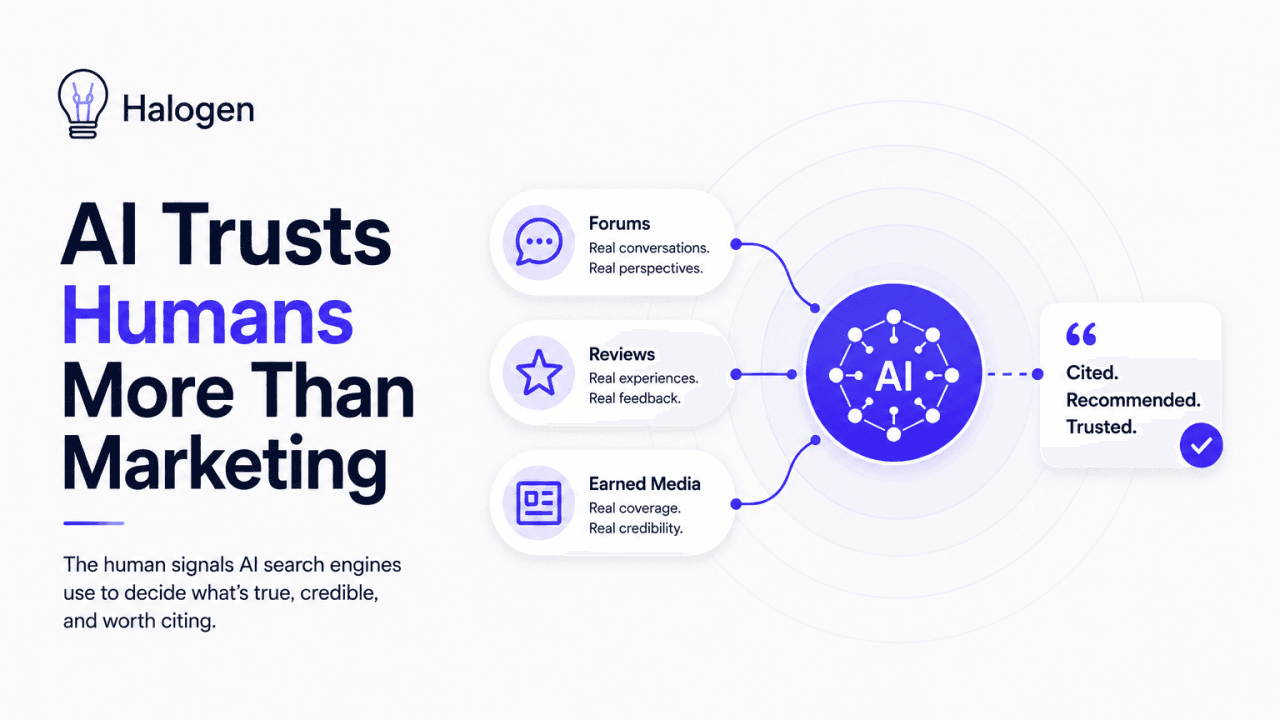
Why AI Trusts Humans More Than Your Marketing
I've spent the last year studying how AI decides who to trust. The answer has nothing to do with how much you spend on marketing. Here's what the research shows — and why authentic human voices in forums, reviews, and press are the only currency that actually matters to an LLM.

I've spent the last year studying how AI decides who to trust. The answer has nothing to do with how much you spend on marketing.
I'm Mario V Adoc, co-founder and CEO of Halogen.
For the past year, I've spent most of my time studying how AI search engines decide what's true, what's credible, and who gets cited when someone asks ChatGPT, Gemini, or Claude a question about a product, a company, or a category.
And most marketers have no idea.
Human voices are the authority signal.
Not your ad spend. Not your content volume. Not the size of your marketing team.
The thing that makes an LLM trust you is the same thing that has always made people trust you: what other humans say about you, in their own words, without you in the room.
Why human input carries so much weight
To understand this, you have to understand how these models are built.
LLMs are not just trained on raw text from the internet. They are trained and then refined using a process called Reinforcement Learning from Human Feedback, or RLHF. Human labelers evaluate competing AI responses and indicate which ones they prefer, and that preference data becomes a reward signal that shapes the model's behavior going forward. The result is a model that has been tuned, at a fundamental level, to reflect human judgment.
That same instinct is baked into how these models determine what is authoritative. Entities that appear frequently, consistently, and in high-quality contexts across the web become embedded as authoritative in the model's weights. You cannot buy your way into that. You earn it through repeated, credible presence in the places where real humans talk.
3 forms of human content that carry the most weight
Based on what the research shows, and what I've observed building Halogen Presence™, three categories of human-generated content carry the most weight with LLMs today.
1. Forum data
Reddit threads are long comment chains where humans argue through a problem in natural language, with context, caveats, and corrections. A single top thread can run 400 comments and 10,000 words. That is the shape LLMs need to learn reasoning patterns from, and it is rare almost everywhere else.
The data backs this up. A June 2025 analysis of over 150,000 citations found Reddit was the most cited domain across LLM responses at 40.1%, beating Wikipedia, YouTube, and Google results.
This is not a coincidence. Reddit is messy, opinionated, and specific. That is exactly what LLMs are looking for. Not polished. Not sanitized. Real.
2. Customer reviews
LLMs digest data from platforms like Reddit, G2, and Trustpilot to form what some researchers call a "consensus opinion." As one observer noted: "An LLM can read your marketing copy, but it trusts your customer reviews. If your site says 'fast shipping' but 500 recent reviews mention delays, the AI will warn users about the delays."
Your own website, counterintuitively, sits at the bottom of the hierarchy for subjective queries. Third-party validation is what moves the needle.
The numbers are hard to ignore. Third-party review profiles on G2, Capterra, and Trustpilot increase citation chances by 3x. Brands mentioned on Quora and Reddit have 4x higher citation likelihood. And despite massive drops in organic traffic, review platforms remain in the top five most cited sources in AI Overviews. They represent just 8.5% of all links, yet three of the top five cited domains are review sites.
According to G2's own research, half of B2B software buyers now start their research with an AI chatbot, up 71% since April 2025. When ChatGPT, Gemini, and Claude describe a vendor the same way, buyers treat that consistency as a trust signal.
3. PR and earned media
Getting quoted or mentioned in editorial publications is not just good for brand awareness. It is LLM fuel. Through RLHF, models learn to prefer certain types of sources and framings. If human raters consistently reward responses that cite academic research, established publications, and expert commentary, the model learns to weight those signals.
A press mention in a high-authority outlet creates a data point that LLMs treat as independently verified. It is third-party human attestation at scale.
Other human signals that carry weight
The three above are the highest-leverage for most businesses. But LLMs also draw heavily from:
Scientific journals and academic papers, which carry the highest authority signal in most domains. Speeches and transcripts, which provide attributed, quotable human perspective. Survey data with named methodology, which LLMs cite as evidence of category-level consensus. Podcast transcripts and YouTube video content, where brand mentions correlate 0.664 with AI visibility compared to just 0.218 for traditional backlinks, with YouTube showing the strongest correlation at 0.737.
But how does an LLM actually know if something was written by a human?
This is the question I get asked most. And the honest answer is: it is complicated, and the gap is closing.
Detection comes down to two core signals that researchers call perplexity and burstiness.
Perplexity measures the unpredictability of text. Human writers surprise readers with unexpected word choices, unusual metaphors, and sudden shifts in tone. They do not always pick the most statistically likely next word. AI-generated text, by contrast, tends toward the middle of the statistical bell curve, choosing words that are appropriate but seldom surprising.
Burstiness is simpler to feel than to define. Read this sentence. Now read one that stretches across a full line, builds through a subordinate clause, and lands somewhere you did not expect it to. That contrast, the short punch followed by the long sprawl, is burstiness. Human writing does this naturally. AI writing tends to smooth it out, producing sentences of consistently moderate length and complexity that feel competent but never quite alive.
Here is a real-world example. A customer review that says "Works great. Saved us hours every week. Our team was skeptical at first, and honestly so was I, but after the first month the results were impossible to ignore" has high burstiness. An AI-written version of that same sentiment would likely read as one uniform, well-structured sentence. Both say the same thing. Only one sounds like a person.
But here is where it gets nuanced. AI-generated text tends to show limited variation in sentence length, more limited word choices, overuse of certain structures, and less use of punctuation compared to human writing. Research confirms that the performance of models trained on AI-generated text is consistently lower than those trained on human-generated content.
The deeper issue is not just detection. It is what AI-generated content does to the information ecosystem when it circulates at scale. When LLM-generated content becomes part of new training datasets, it risks recursive degradation, where the quality and diversity of future models declines over time. This is sometimes called model collapse. It is one of the core reasons the AI research community treats authentic human content as genuinely scarce and genuinely valuable.
The practical implication: an LLM that encounters your brand through a real Reddit thread, a candid customer review, and a bylined press mention is encountering three independent human signals that reinforce each other. A brand that shows up only in its own polished marketing copy is providing one source, authored by itself, that an LLM has every reason to discount.
What this means for your business
AI search is not a new version of Google. It does not reward the loudest voice or the biggest budget.
It rewards the most trusted one.
The businesses that will win in AI search over the next few years are not the ones producing the most content. They are the ones generating the most authentic human conversation: in forums, in reviews, in the press, and in every corner of the internet where real people talk without a marketing team in the room.
That shift has already started. The brands building those signals now are the ones that will be cited, recommended, and trusted by AI when your next customer goes looking.