
How Long Does AI Visibility Take? EasyDeploy AI Went From 0% to 24% in Eleven Weeks
AI visibility takes longer than most founders expect. EasyDeploy AI saw zero results for the first month, then its visibility kept climbing after the six-week sprint ended.

The short version: AI visibility takes longer than most founders expect. EasyDeploy AI saw zero results for the first month. Then Claude and Gemini started recommending it, and its visibility kept climbing after the six-week sprint ended. By November 18, EasyDeploy showed up in 24% of AI answers to the 15 buyer questions we started with, and 27% across all 16 questions we track today. That's more than DataRobot, Akkio or Pecan AI. ChatGPT is the exception. It has mentioned EasyDeploy once.
The question we set out to answer
EasyDeploy AI builds churn prediction, lead scoring and revenue forecasting models for small business finance and RevOps teams, trained on data they already have. Founder and CEO Emanuel Castañeda runs it from New York City, and he made every website change in this case study himself.
His buyers increasingly ask an AI assistant first. In G2's 2026 survey of 1,076 B2B decision makers, 51% said they start software research with an AI chatbot more often than with Google (G2).
That's a big opportunity for a startup, but only if the AI assistants recommend you. So we set out to answer one question: when a RevOps or finance lead asks ChatGPT, Claude or Gemini for help with the problem EasyDeploy solves, does EasyDeploy show up in the answer?
"The ability to track our AI visibility in Halogen Presence has been unmatched to any tools we've seen in the market. Halogen Presence gives us the direction and guidance to make clear and measurable progress."
Emanuel Castañeda, Founder and CEO, EasyDeploy AI, in a G2 review of Halogen Presence
How we measured
We tracked 15 questions, written with Emanuel to match how his buyers describe the problem. None of them mention EasyDeploy by name. They're the questions a buyer asks while they're still figuring out what kind of tool they need, like:
- "How do I build a churn prediction model without a data scientist?"
- "What can I use instead of HubSpot's built-in lead scoring?"
- "Can I use my QuickBooks history to predict which invoices will be paid late?"
We used Halogen Presence to ask each question on ChatGPT, Claude and Gemini every weekday. Each run gives 45 answers, and the visibility score is the share of those answers that mention EasyDeploy. One answer moves the score by about 2 points, so we look at weekly averages rather than single days.
What Emanuel changed
Emanuel made every change himself, in a six-week sprint from early September to October 7 and then lightly through the end of October:
- Opened his site to AI crawlers and added FAQ and pricing schema
- Added an About page with a founder bio
- Wrote six blog posts, most of them answering one specific buyer question each
- Fixed how Bing indexed his blog
His site health score in Halogen Presence went from 45 to 72 out of 100.
Finding 1: The results arrived weeks after the work, and held after it stopped
For the first month there was nothing to see. Every run from the baseline through October 2 came back with zero answers mentioning EasyDeploy. The first mentions came on October 5, from Claude and Gemini, about four weeks after the first changes went live.
Most of the gain came after the sprint ended. In the week the sprint ended, 7.6% of answers mentioned EasyDeploy. By the last week of October it was 22%. Once the work was done, it held and kept edging up: 23% in the first week of November, 25% in the second and 26% so far in the third.
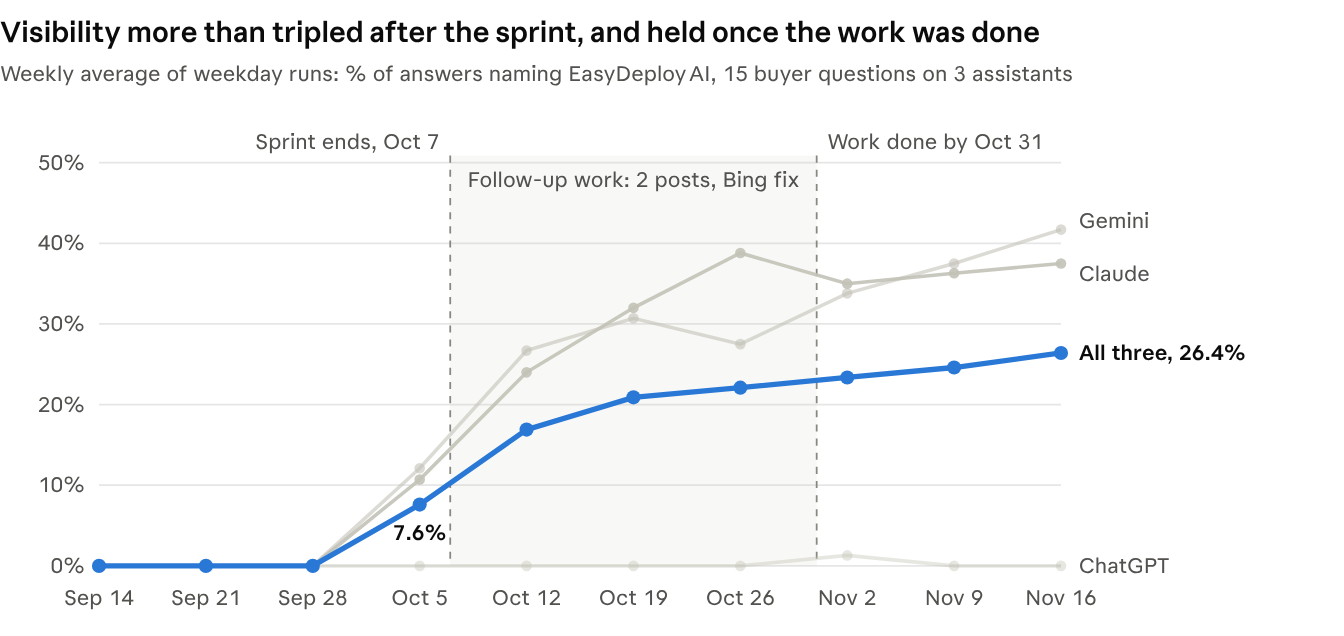
Source: Halogen Presence weekday runs, September 14 to November 18, 2026. The baseline on September 2 was 0%. The week of November 16 has 3 runs so far, and from October 24 the runs include a 16th question.
So why does it take so long? AI assistants pull their answers from search engines. Before an assistant can quote a new page, a search engine has to find it, index it and rank it for the question. Each step takes time. We saw the same slow build with Liddell Stor-It, whose visibility took five months to go from 7% to 43%.
What this means for you: give AI visibility work 8 to 12 weeks before you judge it. If EasyDeploy had checked at week 4, it would have seen zero and might have quit a month before it paid off.
Finding 2: The questions that moved had a page written for them
Every question that got a page written for it ended up with EasyDeploy in the answer, and 5 of the 6 still did on November 18. Here they are:
- "How do I forecast demand from my order history in QuickBooks or Shopify?" Answered by a blog post on forecasting demand from order history.
- "Can I connect Claude to my business data to train models and run predictions?" Answered by a post on connecting Claude to business data.
- "What can I use instead of HubSpot's built-in lead scoring?" Answered by a post on the best lead scoring software. This one dropped out again in the November 18 run.
- "How do I build a churn prediction model without a data scientist?" Answered by a worked example with almost the same title.
- "Looking to predict customer churn but not sure where to start. What tools or platforms actually make it easy?" Answered by a post on the best churn prediction software.
- "What are the best no-code machine learning tools for small businesses?" Answered by a post with almost the same title, published October 17. Claude and Gemini both mentioned EasyDeploy within three weeks.
Questions that only shared a topic with a page didn't move. The lead scoring post answers "which tool should I use?" It showed up for the question asking for an alternative to HubSpot's scoring, but not for the two questions asking how to automate lead scoring.
The pattern isn't perfect. Two questions without their own page, about training a custom model on your own data and about tools for a company without a data team, started showing up on Claude in November.
What this means for you: list the questions your buyers ask, then write one page for each question. Answer it directly near the top, in the buyer's own words. A page on the same topic isn't enough.
Finding 3: ChatGPT barely moved
ChatGPT has mentioned EasyDeploy in one answer in eleven weeks, on November 5, and not in the runs since. Claude and Gemini have mentioned EasyDeploy on several questions in every run since mid-October.
It wasn't for lack of effort, and part of the problem turned out to be Bing. Emanuel had pinged Bing about his new blog posts through IndexNow, a protocol that tells Bing and other participating search engines, though not Google, that a page has changed. But he sent the ping before he had updated the site's routing rules on AWS Amplify, his hosting service, and had to re-submit the blog URLs once the rules were in place.
"Just had to re-submit the blog page URLs because I had run IndexNow before I had updated the routing rules on AWS Amplify."
Emanuel Castañeda
Claude and Gemini found his posts without the ping. That's because each assistant searches a different index:
- Gemini draws on Google Search.
- Claude draws on Brave Search.
- ChatGPT draws on a Bing-class index plus OpenAI's own crawler, OAI-SearchBot.
This is the second Halogen case study where Bing held ChatGPT back. Liddell Stor-It had the same problem: a canonical tag bug kept most of its site out of Bing until it was fixed.
What this means for you: track each AI assistant separately, because an average of three can hide one that's stuck at zero. For ChatGPT, check that your pages are in Bing's index using Bing Webmaster Tools, and allow OAI-SearchBot in robots.txt. If you use IndexNow, only send the ping once your pages load, and send it again after any fix.
How EasyDeploy compares
On the same 15 questions, EasyDeploy went from last place to first, ahead of Pecan AI, Akkio and DataRobot. The lead is four answers out of 45, so it's still a modest one.
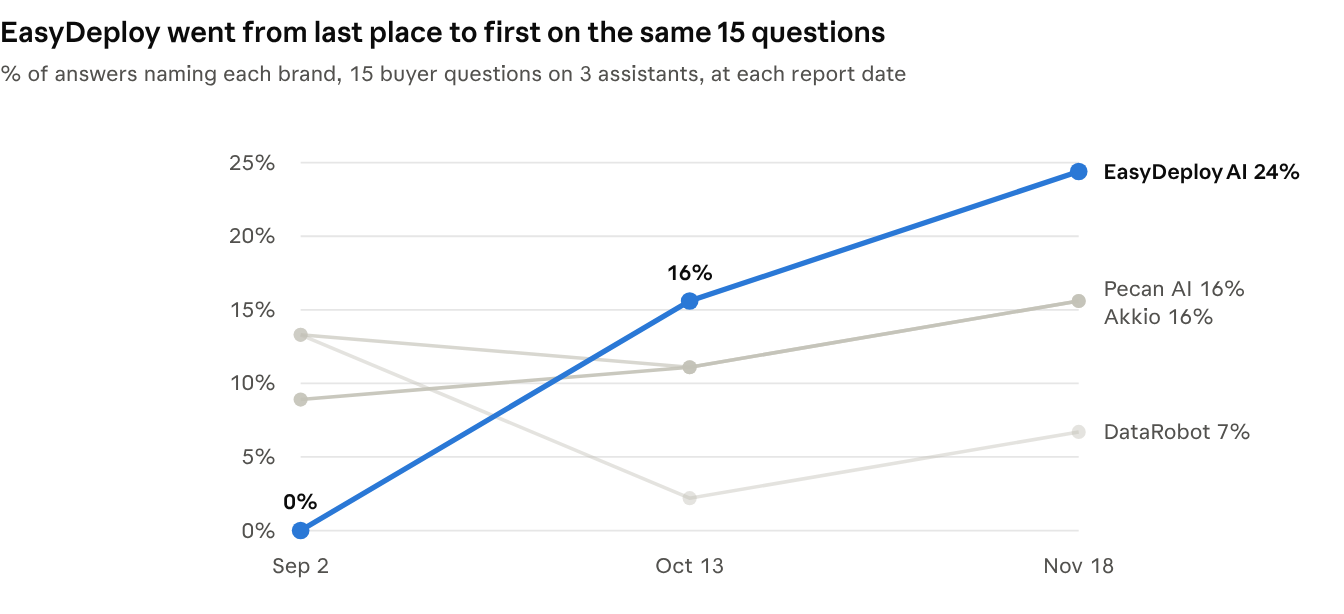
Source: Halogen Presence reports of September 2, October 13 and November 18, 2026, on the original 15 questions.
The competitors' scores moved too, with no involvement from us. DataRobot dropped from 13% to 2% by mid-October, then recovered to 7%. Pecan AI went from 9% to 16%. AI answers shift on their own, so any single report is a snapshot. And these are small business questions, so the ranking says nothing about who wins enterprise deals.
What this case study can't tell you
This is one company over eleven weeks, so there's a lot it can't prove:
- No control group. We can't separate Emanuel's changes from model updates or wider shifts in what assistants recommend.
- Answers vary from run to run. A SparkToro and Gumshoe study found the same list of brands came back less than 1 time in 100 (Search Engine Land). That's why we use weekly averages.
- A small sample. One answer moves the score by about 2 points.
- Visibility isn't traffic yet. Visits from AI assistants are still too few to measure, so we haven't tied any leads or revenue to AI answers.
What we'd tell a founder starting now
- Track questions that don't use your brand name. Questions that include your name make your score look better than it is. New customers find you through the questions that don't.
- Write one page per buyer question. Match the question's intent ("which tool" is not "how do I"), answer it in the first few sentences, and title it the way the buyer asks.
- Give it 8 to 12 weeks. EasyDeploy saw nothing for a month, then most of its gain arrived after the sprint ended, and it held once the work stopped.
- Track each assistant on its own. If ChatGPT stays at zero, check Bing indexing, re-submit pages after any fix, and check OpenAI's crawler access.
- Read trends, not snapshots. Use weekly averages and watch competitors on the same questions, because everyone's scores move.
Common questions
How long does it take to show up in AI answers?
For EasyDeploy, it took about four weeks from the first changes to the first mention, and most of the gain came over the following month. Liddell Stor-It took five months to go from 7% to 43%. Plan on 8 to 12 weeks before you judge the results.
Why do Claude and Gemini mention my business but ChatGPT doesn't?
ChatGPT searches a different index than the other two: a Bing-class index plus OpenAI's own crawl. Check that your pages are in Bing using Bing Webmaster Tools, and that your robots.txt allows OAI-SearchBot. Bing was part of the problem for both EasyDeploy and Liddell Stor-It.
Do I need a developer to do this?
No. Emanuel made every change himself, working from the weekly checklist Halogen Presence gave him.
Which questions should I track?
Questions that don't include your brand name, written the way your buyers actually ask them. EasyDeploy's 15 questions covered churn prediction, lead scoring and forecasting, and none of them mentioned EasyDeploy.
Will AI visibility bring me traffic?
Not right away, in EasyDeploy's case. GA4 has recorded too few visits from AI assistants to measure so far, though some AI visits may be counted as Direct. Organic search visits did grow, up about 70% from the baseline.
About the author
Mario V. Adoc is the co-founder and CEO of Halogen AI and the creator of Halogen Presence. He spent 18 years at Amazon, where he launched Twitch Prime and built the operations platform for Prime Video's live sports. He started Halogen to help businesses see and improve how AI assistants recommend them. He's based in Seattle.
About Halogen Presence
Halogen Presence shows which of your buyers' questions name you in ChatGPT, Claude and Gemini, and which name your competitors. It tells you what to write or fix next, with an effort and impact estimate for each step, then checks whether it worked. Along the way it audits how easily AI can read and quote your site, and shows which sources the assistants cite for you and for your competitors.
Track 50 buyer questions across ChatGPT, Claude and Gemini with Halogen Presence Starter: $99 a month, with a 30-day money-back guarantee. Get started
Sources
- Halogen Presence reports for EasyDeploy AI, September to November 2026, and EasyDeploy's GA4
- G2, The Answer Economy (2026)
- Search Engine Land: AI recommendation lists rarely repeat
- Search Engine Land: Claude visibility and Brave Search rankings
- GEO Toolbox: How ChatGPT search works
- OpenAI: Overview of OpenAI crawlers
- PPC Land: Google's absence from IndexNow